




































Latest News

Sale without consideration is void.

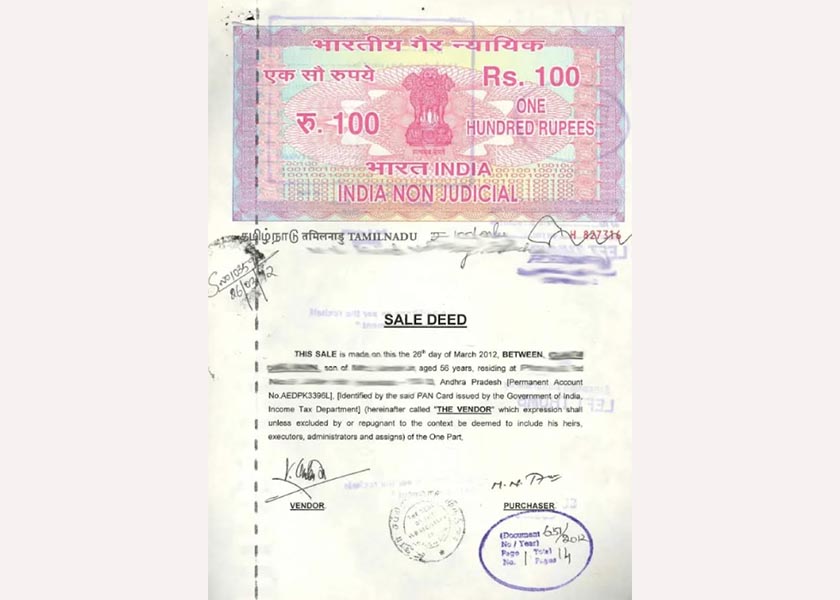
This case concerned a sale deed and arose out of a civil suit that was dismissed by the trial court. The plaintiffs filed a first appeal which was allowed by the district court and the suit was decreed. On the question of limitation, it was held that the limitation period was 12 years applying Article 65 of the Limitation Act, 1963 and the suit was filed within the said period of 12 years. The defendants filed a second appeal in the High Court which was dismissed. On the question of limitation, it was held that the suit was to be filed within 3 years from the date of knowledge (instead of 12 years) applying Article 59 of the Limitation Act, 1963. The legal heirs of the original defendants then approached the Supreme Court and the Supreme Court confined itself to the question whether the plaintiff’s suit was time-barred or not.

The Bench held that in order to ascertain whether Article 65 of the Limitation Act, 1963 would apply to the factual scenario, it has to first determine whether fraud was alleged as regards the contents of the sale deed. Since the plaintiff had not executed the sale deed and the original was also not produced, it was held that Article 59 of the Limitation Act, 1963 would not apply.

The Bench further reiterated earlier law – “If a sale deed is executed without the payment of price, it is not a sale at all in the eyes of law, specifically under Section 54 of the Transfer of Property Act, 1882. Such a sale without consideration would be void and would not affect the transfer of the immovable property.”.

Since there was no sale consideration, the Bench held that in the absence of the sale consideration being tendered, the sale deed would be void and the plaintiff would not be required to seek its cancellation. Therefore, Article 59 of the Limitation Act, 1963 could not be said to be applicable.

The Bench further held that the plaintiff “could indeed have maintained an action to obtain possession of the property on the basis of her title and filed the same within the period of 12 years from the date of knowledge that the possession of the defendant was adverse to that of the plaintiff”. The appeal was dismissed holding that the High Court could be said to have committed an error insofar as applying Article 59 instead of Article 65 of the Schedule to the Limitation Act, 1963. The Bench thus clarified the correct position of law and found no infirmity in the ultimate conclusion of the High Court insofar as the maintainability of the suit on the aspect of limitation is concerned.  

SHANTI DEVI (SINCE DECEASED) THROUGH LRS. GORAN v. JAGAN DEVI & ORS., CIVIL APPEAL NO. 11795 OF 2025, SUPREME COURT – 12 SEPTEMBER 2025.

CALL US 24/7

Need Professional Legal Advice?
Get an Appointment Today!

Navigating complex legal landscapes, we deliver clarity and results.
Transparency and efficiency are our priorities; positive outcomes, our goal.
We offer experienced counsel, careful drafting and customized solutions.

Contact Details

Follow Us

Newsletter

You have been successfully Subscribed! Ops! Something went wrong, please try again.
© 2025 ilaindia.com, All rights reserved.

International Law Affiliates (the “Firm” or “I.L.A.”*) furnishes information on this website in accordance with the Bar Council of India’s guidelines and the Advocates Act, 1961 that govern the practice and professional ethics of advocates in India. This website offers an overview of the Firm and its areas of practice. Online content is for information purposes only and not for advertising. Content featured on this website may not be construed as legal advice. I.L.A. reserves the right to update or edit website content, without prior notice.

By clicking on the “I Agree” button below, you acknowledge and accept that:

  • You have approached I.L.A. for information on the firm’s year of establishment, partners, advocates, affiliates, practice areas, working hours, office contact details, articles, photo gallery and/or other relevant materials/content that we may upload from time to time.
  • There has been no invitation or inducement whatsoever from the Firm, any of its partners, associates, employees, agents etc. to create an attorney-client relationship, or any other legal relationship, through this website.
  • You have read, understood and accepted the  ilaindia.com terms of use available here.

International Law Affiliates®Pasrich & Company® and I.L.A. Pasrich & Company® and the corresponding logos are registered trademarks. International Law Affiliates owns the copyright to the entire website, including the content, layout, formats, design and colour combinations.

All rights in this respect are reserved.

* “The Firm” also includes “I.L.A. Pasrich & Company”, “I.L.A. Pasrich & Co.” and “Pasrich & Company”.