


























Latest News

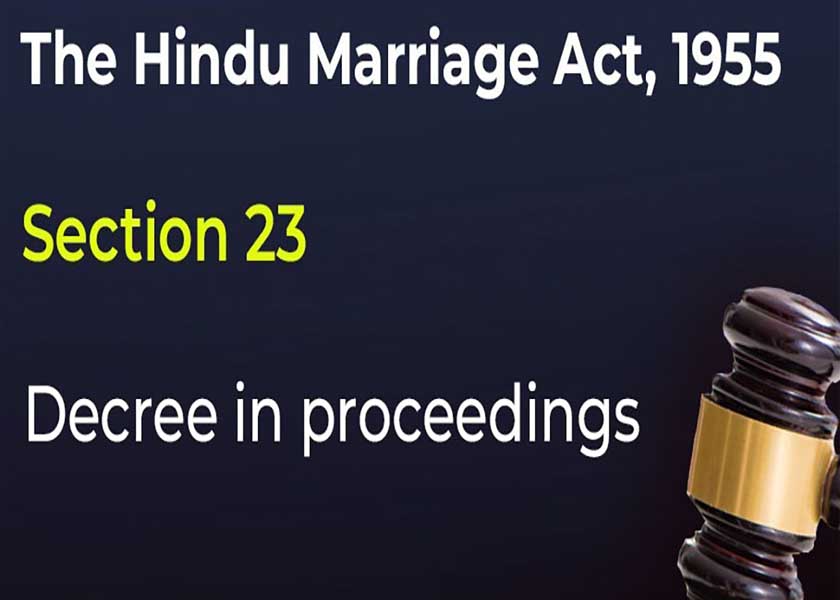
What is ‘own wrong’ to attract the provisions of Section 23(1)(a) HMA.

This case concerns an appeal u/s.19 of the Family Courts Act, 1984 assailing the Judgment and Decree of a Principal Judge, Family Courts, Delhi whereby the divorce petition filed by the husband u/ss.13(1A) and 13(1)(ib) of the Hindu Marriage Act, 1955 (“HMA”) was dismissed.

The primary contention raised by the husband was that there was no valid marriage between the parties, though matrimonial ceremonies were conducted, the husband was under the influence of a sedative substance at that time rendering the marriage voidable and the parties had been living separately for a number of years. The wife contended that she was always willing to rejoin the company of the husband but the husband deserted her without sufficient cause and reason, and she filed a petition for restitution of conjugal rights.

A Division Bench of the Delhi High Court held that s.5 HMA provides for essential conditions for a valid Hindu Marriage, the contravention of which results in a marriage being void as per s.11 and the husband’s case does not relate to contravention of any stipulated conditions. His allegations of being under the influence of a sedative substance could make the marriage voidable for which a petition for annulment had to be presented within one year of discovery. The Bench further held that the dispute about the validity of marriage was challenged by the husband in the wife’s petition for restitution of conjugal rights, and the issue was decided against him and had attained finality.

The Bench further held –

            “after passing of a decree of judicial separation or restitution of conjugal rights, when the parties fail to resume cohabitation for a period of one year or more, a decree of divorce could be granted at the instance of either of the parties… the Court is empowered to examine the conduct of the party seeking divorce and if it finds that the relief is being sought on the basis of the petitioner’s own wrongdoing, the Court may refuse to grant such relief”.

It was further held –

            “On one hand, he disputed the validity of the marriage itself and on the other hand, he sought dissolution of the very same marriage under the garb of Sections 13(1)(ib) and 13(1A) of the HMA. A party cannot approbate and reprobate simultaneously, i.e., disputing the factum of marriage while simultaneously praying for its dissolution under the HMA. Therefore, the said conduct of the appellant evidently falls in the category of ‘own wrong’ and is sufficient to attract the provision of Section 23(1)(a) HMA. Whereas, no positive act has been committed by the respondent to create a situation so as to make it impossible for the appellant to resume cohabitation.”.

The appeal was dismissed.

X v. Y, MAT. APP. (F.C.) 252/2018, DELHI HIGH COURT – 18 AUGUST 2026.

CALL US 24/7

Need Professional Legal Advice?
Get an Appointment Today!

Navigating complex legal landscapes, we deliver clarity and results.
Transparency and efficiency are our priorities; positive outcomes, our goal.
We offer experienced counsel, careful drafting and customized solutions.

Contact Details

Follow Us

Newsletter

You have been successfully Subscribed! Ops! Something went wrong, please try again.
© 2025 ilaindia.com, All rights reserved.

International Law Affiliates (the “Firm” or “I.L.A.”*) furnishes information on this website in accordance with the Bar Council of India’s guidelines and the Advocates Act, 1961 that govern the practice and professional ethics of advocates in India. This website offers an overview of the Firm and its areas of practice. Online content is for information purposes only and not for advertising. Content featured on this website may not be construed as legal advice. I.L.A. reserves the right to update or edit website content, without prior notice.

By clicking on the “I Agree” button below, you acknowledge and accept that:

  • You have approached I.L.A. for information on the firm’s year of establishment, partners, advocates, affiliates, practice areas, working hours, office contact details, articles, photo gallery and/or other relevant materials/content that we may upload from time to time.
  • There has been no invitation or inducement whatsoever from the Firm, any of its partners, associates, employees, agents etc. to create an attorney-client relationship, or any other legal relationship, through this website.
  • You have read, understood and accepted the  ilaindia.com terms of use available here.

International Law Affiliates®Pasrich & Company® and I.L.A. Pasrich & Company® and the corresponding logos are registered trademarks. International Law Affiliates owns the copyright to the entire website, including the content, layout, formats, design and colour combinations.

All rights in this respect are reserved.

* “The Firm” also includes “I.L.A. Pasrich & Company”, “I.L.A. Pasrich & Co.” and “Pasrich & Company”.